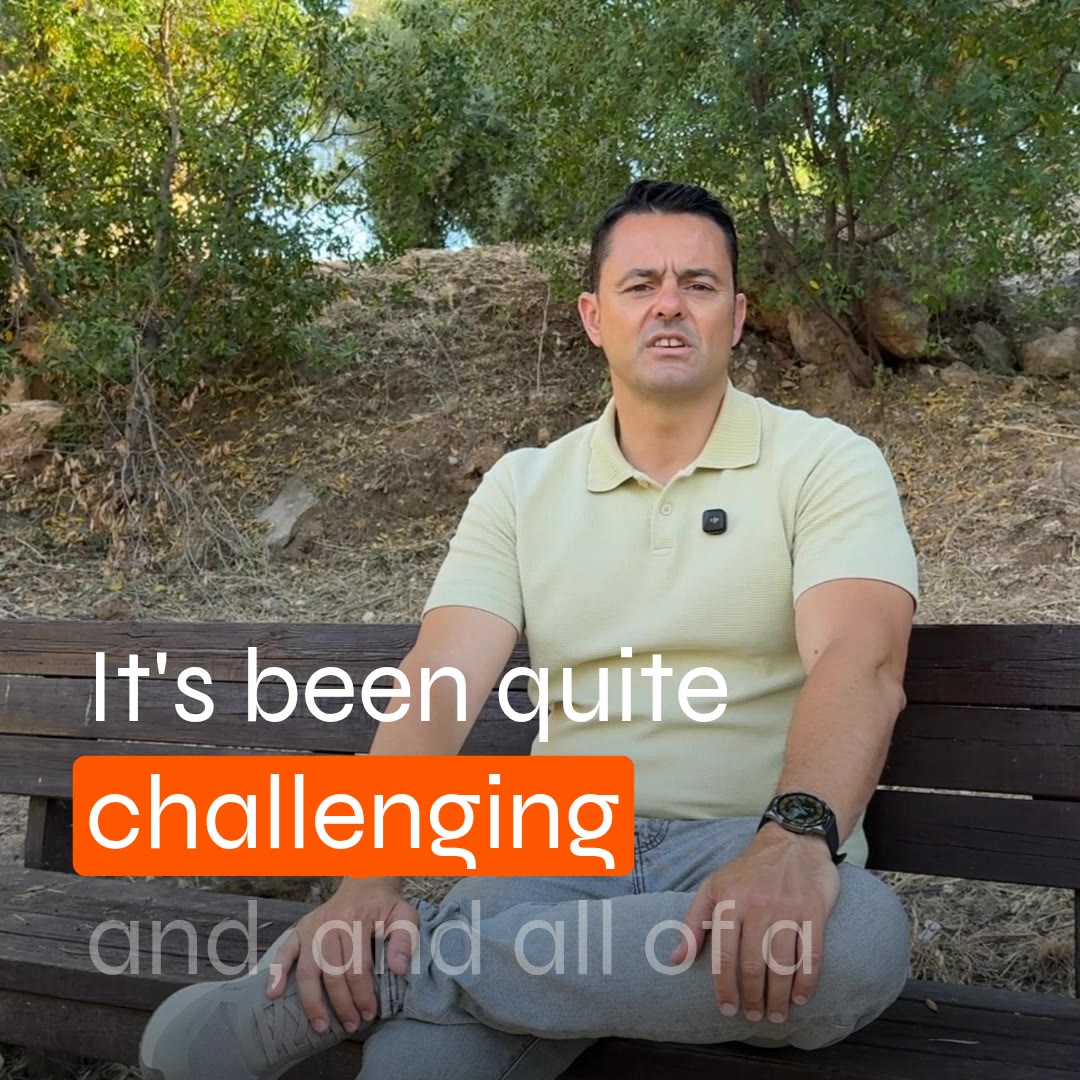
When Manuel first reached out, he told me he was at a crossroads.
He is a lawyer in Malaga. Three kids. Divorced a couple of years ago. On paper, he was doing fine. The career was working. He had friends. He was functioning. And still, something was off.
"These six weeks felt like a whole year. It's like I'm a new guy."
Manuel, at the end of six weeks
Here is how he put it later, in his own words:
I hear this a lot. The outside looks solid. The inside feels like fog. Most people never say it out loud, because saying it feels like admitting the whole thing is fake. It isn't fake. It is just incomplete.
If you are nodding along, you are not alone, and you are not broken. I wrote about exactly this feeling in feeling stuck in your career doesn't mean you're broken.
Manuel decided to say it out loud. And then he decided to do something about it.
In six weeks, Manuel
- Reconnected with his three kids, after years of feeling like their father only on paper
- Discovered through his Ikigai that the career he was about to walk away from was already his purpose
- Named the handful of values he actually lives by
- Rebuilt how he sees himself, from lost to "I have a compass now"
What we actually did
We worked together for six weeks. I am not going to pretend I handed him a magic formula. What I did was help him spot the patterns he was too close to see, and then give him simple tools and a handful of exercises to work on them.
The first thing he noticed was about himself:
"I learned many things from myself throughout this period. It's been like rediscovering me. The most important thing is to feel vulnerable, and Ken knows how to make you accountable and vulnerable."
That word, vulnerable, is most of the work. Vulnerable enough to tell the truth about where you are. Accountable enough to actually move. Those two together are the whole engine.
Manuel is also, by his own happy admission, a great storyteller. He can take you anywhere in a conversation. Which is a gift, and also a very good way to avoid yourself:
A lot of our work was just learning to stop performing and start being honest. With his clients, with the people closest to him, and most of all with himself.
The notebook
The bullet journal
One simple notebook for your tasks, your habits, and a short daily check-in with yourself. The tracker page is where you see, in black and white, where you are showing up and where you are hiding.
One of the first things I gave him was a bullet journal. A simple notebook. People often laugh when I suggest it. Then they try it.
He tracks his habits in it. He writes down quotes. He draws. He even writes little stories for himself, to relax. The part he keeps coming back to is the tracker, because that is where he can see, in black and white, where he is showing up and where he is hiding.
A notebook does not look like much. But for someone whose head was running in twenty directions, it became the one place he could hear himself think. If you want the longer version of why I swear by this, I wrote about it in seven years, one notebook.
The exercise that surprised him most: his Ikigai
This is the part I most want you to read, because it is the one that surprises my clients again and again.
Ikigai
Map four things: what you love, what you are good at, what the world needs, and what you can be paid for. Then look at where all four overlap. That overlap is your Ikigai, your reason to get up in the morning.
Manuel was half-convinced the answer was a brand new life. A pivot. A different career somewhere over the horizon. So we did his Ikigai: four simple questions about what you love, what you are good at, what the world needs, and what you can be paid for. You map them, and you look at where they overlap.
His answers were rich. What he loves: philosophy, connecting with people, growing, technology. What he is great at: improvising, adapting, solving problems, seeing past the obvious, making decisions, being noble. What the world needs: fighting for justice, bringing people together. What he gets paid for: investigating, advising, supporting, guiding.
He expected something new to land in the middle. Instead, one word landed there:
Lawyer.
It was already his. He had just forgotten why he started. The thing he was quietly thinking about walking away from turned out to be the exact place where everything he loves, everything he is good at, and what he believes the world needs all meet. The same week, he won a case with a move in court he described as a kind of magic, turning a prosecution witness into a witness for the defence. That is not a job. That is the Ikigai working.
Most of the successful people I work with assume the answer is out there, somewhere they haven't looked yet. Often it is right under their feet, just out of focus. If you want to try the same thing, don't only write it. Read your Ikigai out loud. It changes what you hear.
Naming what he actually lives by
Values Mapping
Write the things you actually live by, then cut the list down to the few that are non-negotiable. The ones left standing are your real compass for the hard decisions.
Before the Ikigai, we did the slower work of values. Manuel built a long list, then we cut it down to the few he actually lives by, not the ones that sound good on a wall: Self-Love, Warrior, Family.
One small moment changed how he saw himself. He kept calling Warrior a value. I offered him a different way to look at it. A value is something you choose to live by. Warrior was not something he chose. It was who he already is, underneath everything. Naming it as a value was actually making it smaller. That landed. If you have never done this properly, here is the exact values exercise we used.
How the people who love him see him
The skills mirror
Email five very different people who know you well and ask one question: what are the three to five things I am good at? Then compare what they say to the story you tell about yourself.
Then came my favourite piece of homework. I asked Manuel to email five very different people who know him well, his daughter, a close friend, a favourite client, and to ask them one question: what are the three to five things I am good at?
He was nervous about it. A lot of high-functioning people are, because somewhere underneath they suspect the people around them don't really see them.
His daughter's first word was "generous." When he read it, he said something I won't forget: "I see now how they see me. I thought they didn't see me this good." The picture the people closest to him painted was warmer and kinder than the one he carried of himself. That gap, between who you think you are and who the people who love you already see, is some of the richest ground in this whole process. It is also the heart of the True Self work I do with everyone.
His kids
The thing that moved the most was his family.
After the divorce, Manuel had drifted away from his three kids. He was their father on paper. He provided. But he was not really there, and he knew it.
This is the part I care about most. You can fix a calendar or a financial plan in a few sessions. Repairing the way you are with your children is slower and quieter, and it matters more than anything else on the list.
A compass again
Somewhere in those six weeks, Manuel stopped looking for a brand new life and started recognizing the one he already had. He found his way back to who he is.
"I have a compass now in life. Before, I didn't know who I was. I was lost. Now I know who I am. I'm like Don Quixote. I'm a warrior, and I fight for what is right. I fight for my clients, I fight for my family, and more importantly, I fight for myself."
He had been fighting for everyone but himself for years. That last line is the whole shift.
Six weeks
Near the end, he said something that has stayed with me:
Almost every part of his life moved in those weeks. Not because of me, and not because of a single trick. Because he was finally honest about where he was, did a few good exercises that showed him what was already true, and then did the small, unglamorous work of showing up for himself, one notebook page at a time.
Manuel chose to share his story on camera, in his own words, so that someone reading this might recognize themselves in it. If you are the person who looks like you are doing well but quietly feels lost, his story is for you.
Manuel is not the only one. You can watch more stories like his, and read how the coaching actually works, on the coaching page.
What would your six weeks look like?
Two ways to start
If you are ready to talk, book a Life Diagnostic. 90 minutes, just you and me, making sense of where you are. No commitment beyond that. If you would rather start on your own, the Life Report takes about five minutes.