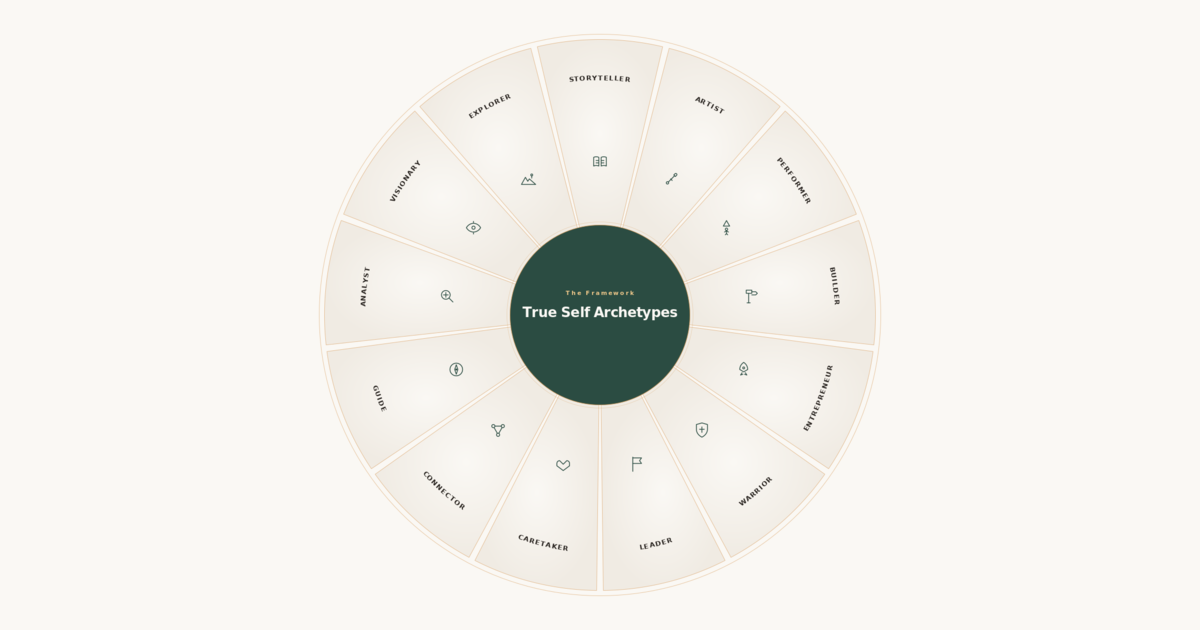
Every person is born with a particular set of instincts, natural gifts, and ways of engaging with the world. These traits are not learned or shaped by circumstance. They are present from childhood and remain consistent throughout a lifetime.
The True Self Archetype framework identifies 13 of the most common patterns. Each archetype describes a distinct way of being naturally wired: how a person thinks, what they are drawn to, and where their deepest strengths lie. Click any card to explore it in full, or take the quiz below to find your primary type.
Not sure which one is you? The quiz takes five minutes and surfaces your primary archetype.
Take the QuizHow to use your result
The framework identifies a primary archetype and often a secondary. The primary is the pattern that runs deepest, present since childhood and consistent across contexts. The secondary tends to show up in specific roles or situations and is often just as revealing.
Most people recognise their primary immediately. If two feel equally strong, pay attention to which one was more visible before the age of twelve, before adult roles and expectations had fully set in. That is usually the more reliable signal.
The practical value of knowing your archetype is clarity. It helps explain why certain kinds of work feel energising and others feel draining, why some environments bring out your best and others don't, and what a career or life built around your actual strengths would look like rather than the version shaped by circumstance or expectation. None of the 13 archetypes is better or worse than the others. They are simply different ways of being wired.
The research behind the framework
The True Self Archetype framework draws on three separate research traditions. In the 1960s, British psychoanalyst Donald Winnicott described what he called the True Self and the False Self. The True Self is the original, spontaneous self: the person you are before the world has shaped you into what it rewards or expects. The False Self is the adaptive layer built in response to those pressures. Over time, for most people, the False Self becomes the dominant version. Recognising the difference is the starting point for meaningful change.

That tradition informed two further research layers. Carl Jung proposed that universal patterns of human character appear consistently across cultures and throughout history. Not personality traits shaped by experience, but fundamental orientations: deep-seated ways of engaging with the world that are, to a significant extent, built in. Howard Gardner's theory of multiple intelligences added a complementary dimension, demonstrating that human intelligence is not a single capacity but a profile of distinct types, and that those differences are visible in children well before formal education begins.
The 13 archetypes were developed from these three traditions. Each archetype combines a motivational orientation (Jung), a natural intelligence profile (Gardner), and the Winnicott premise that these traits are not constructed but uncovered. The framework also draws on the Hindu concept of Dharma: the idea that each person carries a unique set of gifts and a purpose that belongs specifically to them. More on the Dharma connection here.
A note on what this is and is not
The True Self Archetype quiz is a tool for self-reflection, not a clinical assessment. It is not a substitute for psychological testing, and the results should be treated as a starting point rather than a verdict.
What the framework offers is a useful language for a question most people find difficult to answer clearly: who are you, underneath the roles, adaptations, and expectations you have accumulated over the years? That question, once properly engaged, tends to surface the gap between who a person actually is and how they are currently living. That gap is usually where the most valuable coaching work begins.