In 2017, I got fired from a job I loved. Head of Product at a startup called 29k. We'd achieved a lot together, but our paths were diverging and it was time to go separate ways.
It's never fun to be let go. The timing is never quite right. But it gave me something I hadn't had in years: space to think.
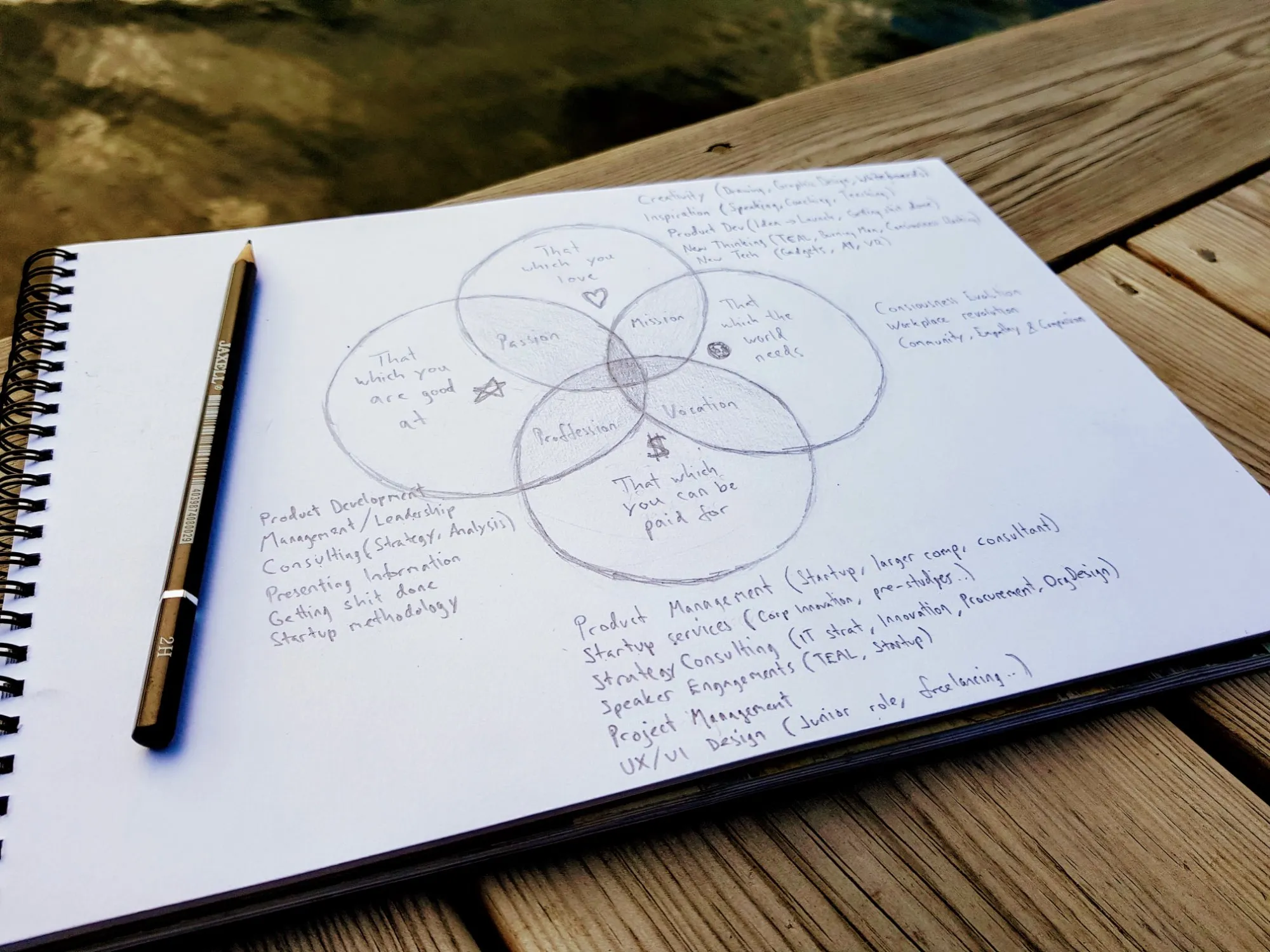
I decided to set aside three months to figure out what I wanted to do the next time I grew up. And the first thing I did was draw four overlapping circles in a notebook.
This post is based on something I wrote on Medium back then. I've updated it with what I've learned since... including the part where I actually found my answer.
What is Ikigai?
Ikigai is a Japanese concept that translates roughly to "reason for being." It's a framework built on four overlapping questions:
- What do you love?
- What are you good at?
- What does the world need?
- What can you be paid for?
Where these four circles overlap, you find your Ikigai. Your reason to be.
In the intersections between pairs, you find your passion (love + skill), your profession (skill + pay), your vocation (pay + need), and your mission (need + love). Get all four to line up and you've found something worth building your life around.
Why I keep coming back to it
I first drew those circles in 2017. I've drawn them again at least six times since. Because here's what nobody tells you about purpose: it's not static.
The world keeps changing. You keep changing. Your skills evolve. New opportunities show up. Old passions fade. New ones emerge.
I think of Ikigai as a compass. It won't tell you exactly what to do next or how to get where you want to go. But it gives you a sense of direction. And when you're feeling lost, direction is everything.
How it actually works in practice
When I sat down that first time, I grabbed a notebook and drew the four circles by hand. I started filling in what came to mind. It was messy. Half the things I wrote down, I crossed out. Some answers surprised me.
The magic isn't in getting it perfect. It's in what happens to your brain when you start mapping things out. You start seeing patterns. Connections you missed. Ideas that wouldn't have surfaced if you'd just kept it all in your head.
I posted a photo of my messy notebook on social media. The picture was taken from an angle and was hard to read. But people read it anyway. The response was incredible. Almost 2,000 people reached out. Turns out, a lot of us are asking the same questions.
The hard part nobody warns you about
The four questions sound simple. They're not.
"What do I love?" is easy when you're 22. At 40, with a mortgage and kids and a decade of identity wrapped up in a career... it gets complicated.
"What am I good at?" is tricky because you've probably gotten good at things you don't actually enjoy. Your best skill might be the thing that's draining you.
"What does the world need?" can be paralyzing if you think too big. You don't need to solve climate change. What specific problem, for specific people, can you help with?
"What can I be paid for?" is where dreams meet reality. And that's not a bad thing. Constraints make the exercise useful instead of just aspirational.
What happened to my four circles
In 2017, I identified three potential directions. All in product development. All reasonable. All... fine.
None of them made my body light up.
It took a few more rounds of the exercise, a move to Spain, and a lot of honest conversations before the real answer emerged. Coaching. Helping other people navigate the same kind of crossroads I'd been through.
I use Ikigai with my coaching clients now. Not as a one-time exercise, but as a living document. Something you revisit, refine, and let evolve as you do. If you want the practical how-to, I wrote 5 tips for working through your own Ikigai.
Try it yourself
If you're feeling stuck or directionless, start here. Grab a piece of paper. Draw four circles. Start filling them in. Don't overthink it. Let it be messy.
Then sleep on it. Revisit it. Talk about it with someone you trust. Keep going until something starts to feel right. You'll know it in your body when you're onto something.
And if you want a structured starting point, try the Life Report. It won't hand you your Ikigai, but it'll show you where things are out of balance. That's usually the best place to start pulling on the thread.