When I first came across Anne-Laure Le Cunff, I felt like I was reading about a parallel version of my own life.
She worked at Google. I worked at Google. She left to build her own thing. I left to build my own thing. Hers became Ness Labs, a community around mindful productivity and intentional learning. Mine became a coaching practice and a podcast.
Both of us spent years in startups, got deep into the ambition loop... and eventually stepped off it. Both of us ended up spending a lot of time thinking about the same questions. What is purpose? Why do smart people with "good careers" feel so empty? How do you actually figure out what you want?
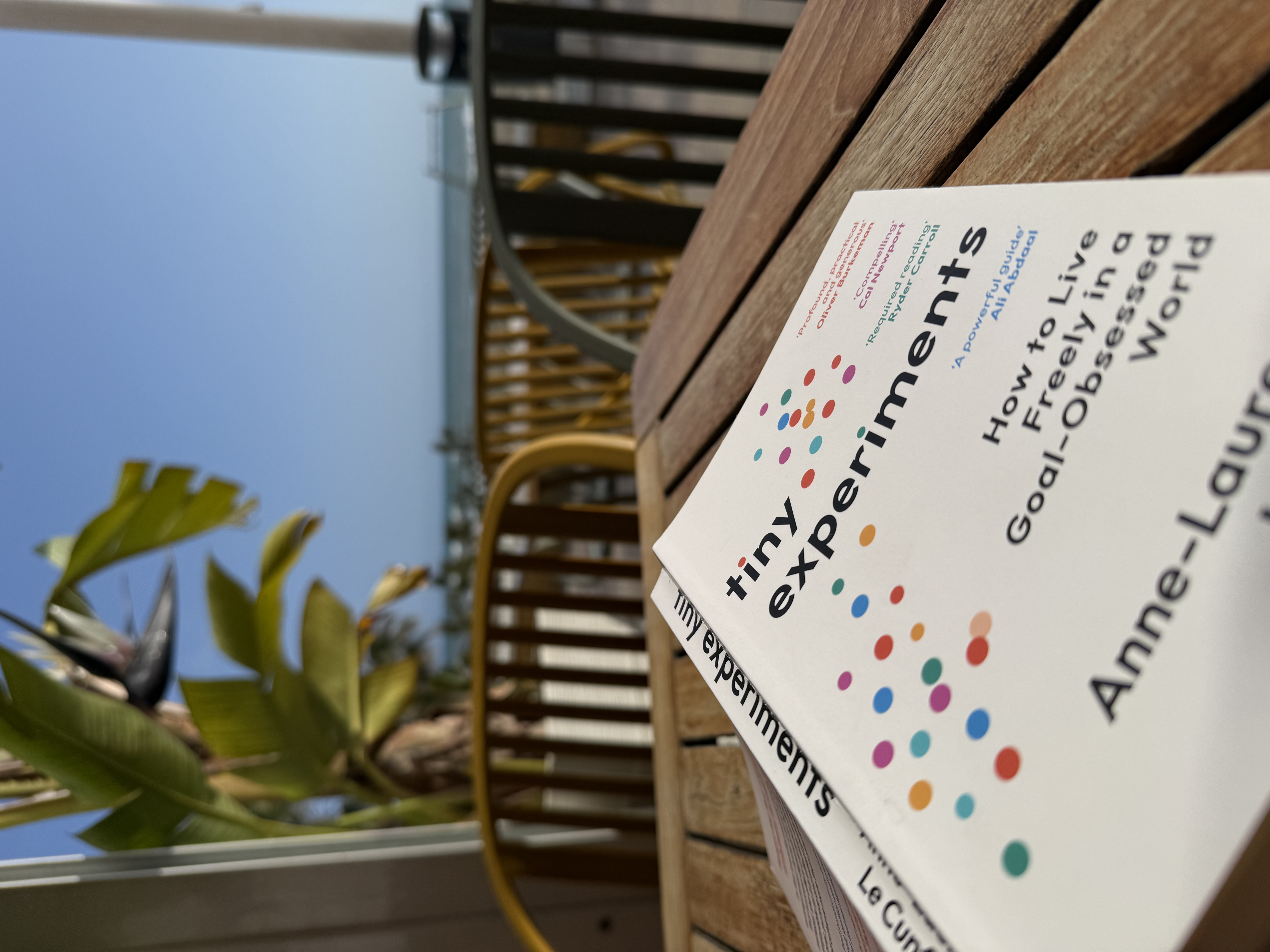
So when she wrote a book called Tiny Experiments: How to Live Freely in a Goal-Obsessed World, I picked it up immediately. I finished it in two sittings.
What the book is actually about
The core idea is this: instead of setting a big goal and grinding toward it, run experiments. Small, time-boxed, low-commitment ones. Not because ambition is bad. But because you often don't know what you want until you've tried it.
Le Cunff is a neuroscientist who left Google to build Ness Labs, a community around mindful productivity and intentional learning. She's not theorizing from a distance. The book is field notes from someone who's built her entire career around this approach.
The premise that got me: goals assume you already know where you want to go. Experiments assume you don't. And if you're honest with yourself, for most of the interesting questions in life... you don't.
The part that changed how I think about passion
There's a version of "find your passion" advice that I've always found quietly useless. The idea that passion is a fixed thing somewhere inside you, waiting to be discovered. That if you just meditate enough, journal enough, take enough personality tests... it will reveal itself.
It doesn't work that way. At least it didn't for me.
What Le Cunff argues (and what I've seen play out in coaching conversations too) is that passion doesn't precede action. It follows it.
You don't identify what you're passionate about and then do the thing. You do things, notice what pulls you in, and passion emerges from the doing. The experiment comes first. The clarity comes after.
I've lived this. I didn't know I'd love coaching until I started doing it. I didn't know Malaga would feel like home until I moved here. I didn't know a podcast about lunch conversations would become one of the most meaningful things I've done until I had the first one.
None of those were goals. All of them were experiments.
Why this matters if you're feeling stuck
A lot of people I work with are stuck in a very particular way. They're not stuck because they lack options. They're stuck because they feel like they need to know where they're going before they start moving.
"I need to figure out what I actually want before I make any changes." I hear this a lot.
The problem is that's not how figuring out works. You don't think your way to clarity. You try your way there.
That's the shift the book is really proposing. Not "have less ambition." More like: hold your direction loosely and let the experiments tell you something.
It connects directly to how I use the Ikigai framework in coaching. You don't fill in four circles perfectly and arrive at your answer. You sketch something, run in a direction, notice what feels alive, and redraw the circles. It's iterative. Always has been.
What a tiny experiment looks like in practice
Not a pivot. Not a leap. Not burning down your current life.
A tiny experiment is something like: for the next 30 days, I'm going to spend one evening a week doing X. Not forever. Not as a new identity. Just to see what happens.
Maybe X is writing. Maybe it's mentoring someone. Maybe it's the pottery class you've walked past for two years and never entered.
The crucial thing Le Cunff builds in is permission to stop. The experiment ends. That's the design. If you've gathered enough signal, you either keep going or you don't. Either outcome is useful. Neither is failure.
That's the real gift of the framing. It removes the pressure that makes people freeze before they've even started.
I'm trying to get Anne-Laure on the podcast
Since reading the book, I've been reaching out to Anne-Laure Le Cunff about joining me for a 50 Lunches conversation. She'd be a natural fit. A neuroscientist who left a comfortable corporate path, built something entirely her own, and wrote a book about living experimentally rather than optimizing toward a fixed destination.
Watch this space :)
In the meantime, I talked about a lot of these ideas with Valentina Quarta in the episode below. She has a concept she calls the "purpose ladder" that captures the same spirit. Purpose isn't a destination. Each rung reveals the next one.
One thing worth trying this month
If any of this resonates, here's a small experiment for you.
Pick something you've been curious about for a while. Not the big direction question. Something specific. Something you could actually try.
Give it 30 days. One session a week. No pressure to turn it into anything. At the end, just ask: what happened? What did I notice? What do I want more of?
That's it. That's the experiment.
The data you get will tell you more than any personality test. More than most goal-setting exercises. Probably more than this blog post.
And if you want to see where the gaps and friction are in your life right now, the Life Report is a useful starting point. It won't tell you which experiment to run. But it'll show you where one might be worth running.