There's a moment a lot of people in their 40s describe, and it's surprisingly hard to put into words.
Things are going well, objectively. The career has progressed. The income is fine. People respect them. From the outside, it looks like success.
And yet something feels flat.
Not unhappiness exactly. Not a crisis. More like... they've been playing a game, and recently they've started to wonder if it's actually the right game.
Most people assume this is a problem with them. A midlife thing. Maybe ingratitude. Maybe restlessness.
What if it's none of those?
There's actually a map for this
Three thinkers have been drawing it from very different angles. One looks at civilisations. One looks at individuals. One looks at organisations. But they're all describing the same thing: humans outgrowing a stage that served them well, and finding themselves on an unfamiliar edge.
The civilisational layer: Harari
Yuval Noah Harari, in Sapiens, makes the case that human societies evolve through shared stories. What we believe collectively shapes what we build, how we organise ourselves, and what we reward.
The dominant story of the last few centuries is the achievement story: progress through rational thinking, individual performance, measurable outcomes, competitive success. Science over superstition. Merit over birthright.
It's a good story. A really good story. It produced medicine, democracy, and the kind of career your parents could point to and feel proud of.
But Harari's deeper point is this: stories that serve humanity at one stage don't serve it forever. The myth of progress doesn't hold up when you're the one who has achieved it, and it still feels like something's missing.
The individual layer: Spiral Dynamics
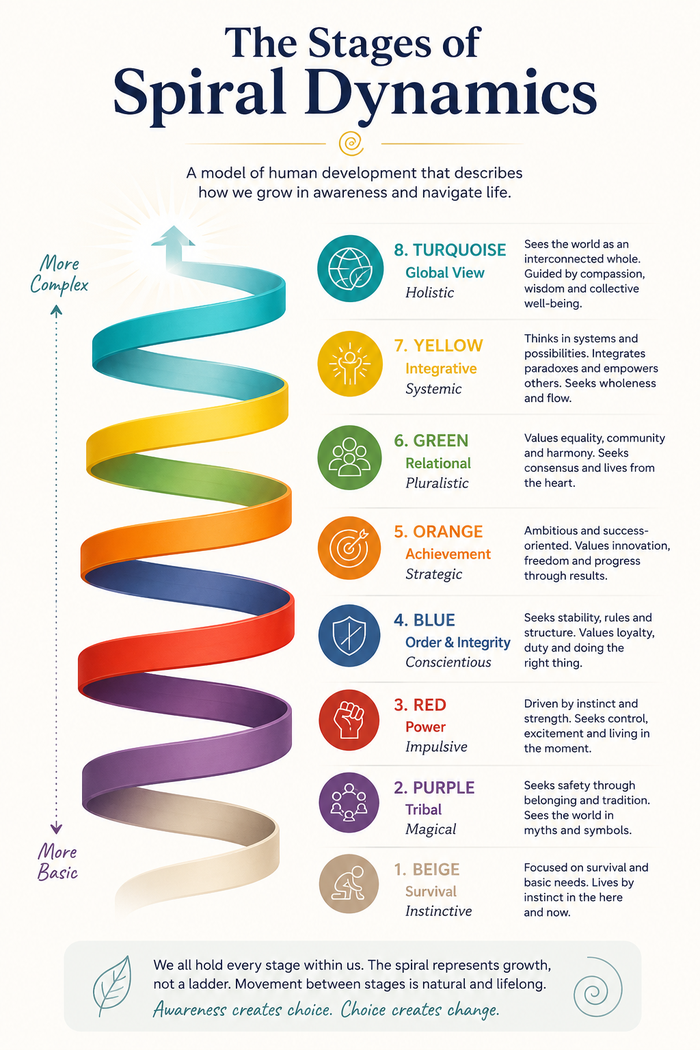
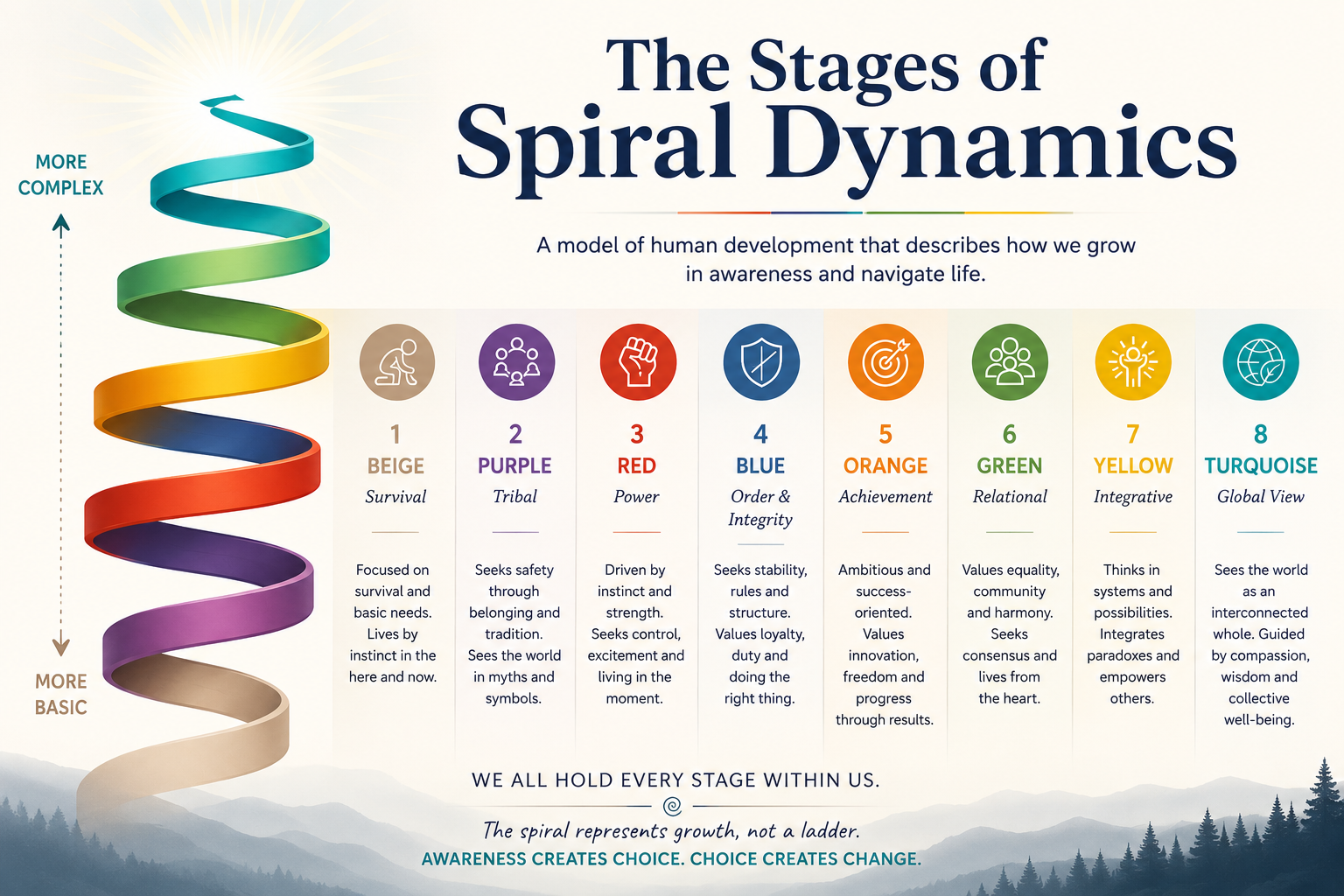
A psychologist named Clare Graves spent decades mapping how individuals and cultures move through distinct stages of values and worldview. His research became the foundation of what's now called Spiral Dynamics, later developed by Don Beck and Christopher Cowan.
The model uses colors. Each stage isn't better or worse than the one before. Each one solves problems the previous stage couldn't, and creates new ones of its own. There are eight in total. The ones most relevant to anyone who has built a successful career:
Blue (Order + rules). Identity comes from belonging to something greater: an organisation, a cause, a tradition. The rules are clear, follow them and you belong. Many careers start here, or find stability here after a period of chaos.
Orange (Achievement). This is where most high-performers live. Drive yourself by your own standards. Optimise, compete, measure. Orange built most of the companies you've worked for. It rewards excellence and individual initiative, and it delivers results.
Green (Purpose + belonging). Orange starts to feel hollow when you've won the game and the question "what for?" won't go away. Green cares about relationships, meaning, and collective wellbeing alongside results. "What are we actually for?" starts to feel more important than "what's the number?"
Yellow (Systemic thinking). The ability to hold multiple perspectives at once, to see the whole system, to draw from earlier stages without being trapped in any of them. Rare, but it's what the most adaptable leaders and thinkers tend to operate from.
Turquoise (Global view). The highest stage in Spiral Dynamics. Sees the world as an interconnected whole, guided by compassion, wisdom, and collective well-being. Rare enough that most conversations about development stop at Yellow.
The key insight: you can't skip stages. And the move from Orange to Green isn't a collapse. It's a graduation.
The psychological layer: Robert Kegan
Robert Kegan, a developmental psychologist at Harvard, maps something very similar at the level of the individual mind. He describes five stages of adult development. Three are particularly relevant here.
The Socialized Mind (Stage 3) derives its values and identity from outside itself. You absorb the rules of the game and succeed by meeting the expectations of the people and institutions around you. This maps well to Blue.
The Self-Authoring Mind (Stage 4) generates its own values from the inside. You're no longer defined by what the organisation expects. You have your own standards and your own drive. This is classic Orange territory, and it's what most high-performers have developed.
Then there's Stage 5: the Self-Transforming Mind. This is where the model gets interesting. The Self-Transforming Mind can hold multiple frameworks simultaneously. It sees the limits of any single system, including its own. It's less attached to any particular identity and more interested in connection across difference. This is the psychological territory that maps to Green and Yellow.
Kegan's research suggests most adults spend their lives at Stage 3. But for the people I work with, that's often not the problem. They've built a strong Self-Authoring identity. The question is what comes next.
The organisational layer: Laloux
Frederic Laloux's Reinventing Organizations takes a similar developmental lens and applies it to companies. Worth noting: Laloux uses his own colour system. His highest organisational stage he calls Teal, which is his own term. It draws from the same developmental tradition as Spiral Dynamics but isn't identical to it. Laloux's Teal roughly corresponds to the Yellow-Turquoise range in Graves' model.
Most of us have spent our careers in what Laloux calls Orange organisations: hierarchy, performance metrics, growth targets, individual accountability. Effective. But a poor fit once you've started asking Green questions inside them.
If you've ever felt increasingly out of place in a culture you used to thrive in, that friction is often developmental. Not the organisation failing you. You asking different questions.
I've written more about this in Reinventing Organisations: Why 69% of Us Are Still Miserable at Work if you want to go deeper on the organisational side.
What this means in practice
When people come to me feeling flat, stuck, or quietly dissatisfied despite outward success, this is usually what's underneath. They're mid-transition. Not broken. Moving from one stage of values and identity to the next.
What the model adds is a reason. You're not doing this because something went wrong. You're doing it because something went right. You succeeded completely at one stage, and now the next one is knocking.
Antonio described this in one of our conversations. He hadn't failed at anything. He'd succeeded at everything. But he was running a playbook built for a version of himself he'd outgrown. The rules still worked. They just weren't his rules anymore.
Resistance usually points toward something important. So does the flatness. And so does the sense that the rules you've been playing by have started to feel borrowed.
You're probably not what you think
You're not lazy. You're not ungrateful. You might just be outgrowing a stage that served you well for a long time.
If the map helps, here are the books worth reading in roughly this order: Sapiens for the civilisational context, Reinventing Organizations for the organisational application, and Kegan's In Over Our Heads for the psychological depth. They make each other clearer.
And if you'd rather explore it in conversation, the Life Report is a good place to start. Or here's how I work with people going through exactly this.
One question worth asking yourself: if the rules you've been playing by stopped being the rules tomorrow, what would you actually want to do?