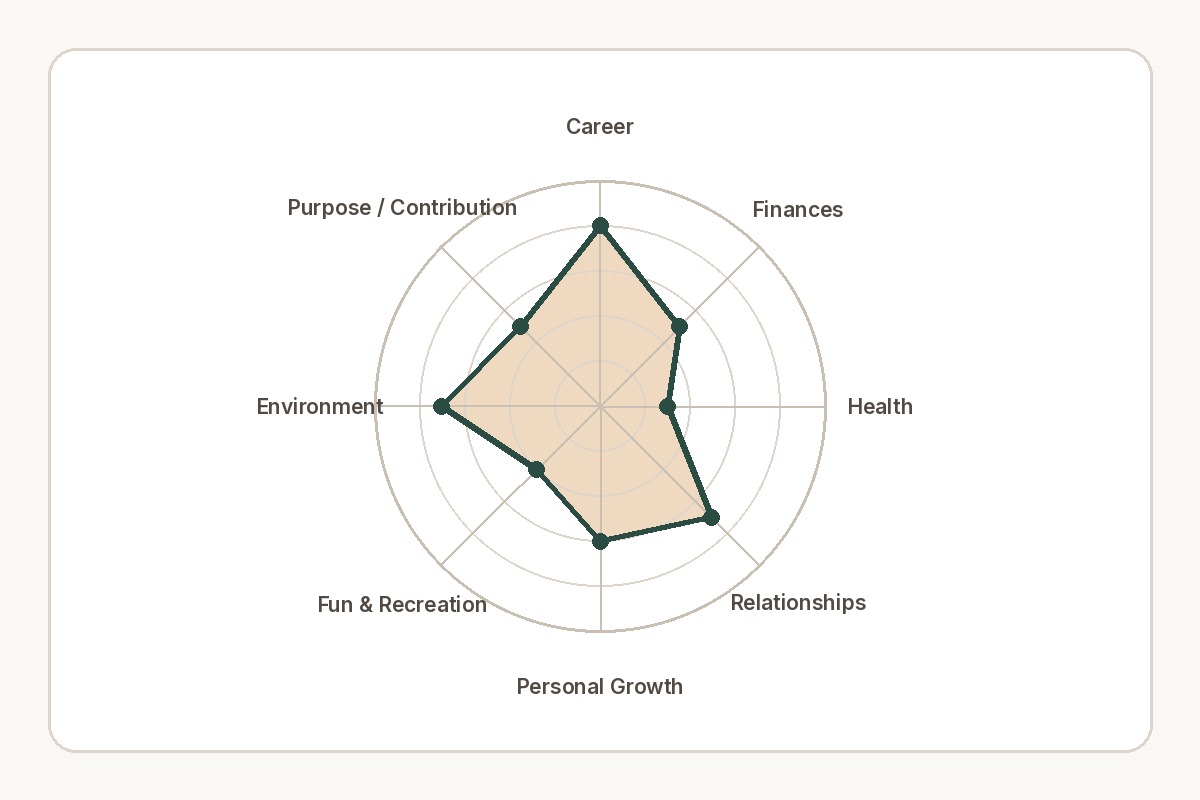
If you've ever worked with a coach, you've probably scored eight areas of your life and joined up the marks. It is one of the most used exercises in coaching, and for good reason.
The version I use is called the Life Report. It's my adaptation of a classic coaching exercise commonly known as the Wheel of Life. The exercise itself is long established and belongs to nobody. Only the name and the presentation here are mine.
It's simple. It's visual. And it has a way of cutting through the noise to show you what's actually going on.
How it works
The concept is straightforward. You rate your satisfaction across 8 key areas of life on a scale of 1 to 10:
- Career & Work
- Finances
- Health & Fitness
- Relationships
- Personal Growth
- Fun & Recreation
- Physical Environment
- Purpose & Meaning
Plot those scores on a spider chart and you get a visual snapshot of your life. If everything was a 10, you'd have a perfect circle. In reality, most people's charts are... lumpy.
And that's where it gets interesting.
Why it works
We're not great at holding our whole life in our heads at once. We tend to focus on whatever's loudest. The work deadline. The argument with our partner. The health scare.
The chart forces you to zoom out. When you see all 8 areas side by side, patterns emerge that you'd miss otherwise.
Maybe your career is an 8 but your health is a 3. That's not balance. That's a crash waiting to happen.
Maybe everything is a 6. Nothing's terrible, but nothing's great either. That "fine" feeling that slowly eats you alive? This is what it looks like on paper.
What your scores actually mean
The low scores are obvious. These are the areas that need attention. But don't rush to fix the lowest one first. Sometimes the lowest score is a symptom, not the cause.
The high scores matter too. These are your energy sources. The things that keep you going. Protect them. If you sacrifice your 8s to fix your 3s, you'll end up with all 5s. That's not progress.
The gap between areas is where the insight lives. A big gap (say, Career at 9 and Relationships at 3) usually means you've been pouring all your energy into one bucket at the expense of another.
How coaches use it
In coaching, the Life Report is usually the starting point, not the destination. It tells us where to look, not what to do.
After you see your chart, the real questions begin: Why did you score Health a 4? What would a 7 look like? What's one thing you could do this week to move it from 4 to 5?
It also creates accountability. When you reassess in 3 or 6 months, you can see exactly what changed. That visual progress is powerful.
Try it yourself
I've built a free Life Report that goes beyond the basic version. It takes about five minutes, gives you a visual map of your life, and sends you a personal report with three things worth focusing on next.
No sales pitch. No spam. Just a clear picture of where you stand and what might be worth your attention.
Because sometimes the most useful thing isn't a new strategy or a motivational quote. It's just seeing things clearly.