The word "Dharma" tends to land in one of two ways. Either it feels profound and a bit out of reach. Or it sounds like something you'd find embroidered on a yoga mat.
Neither version is that useful.
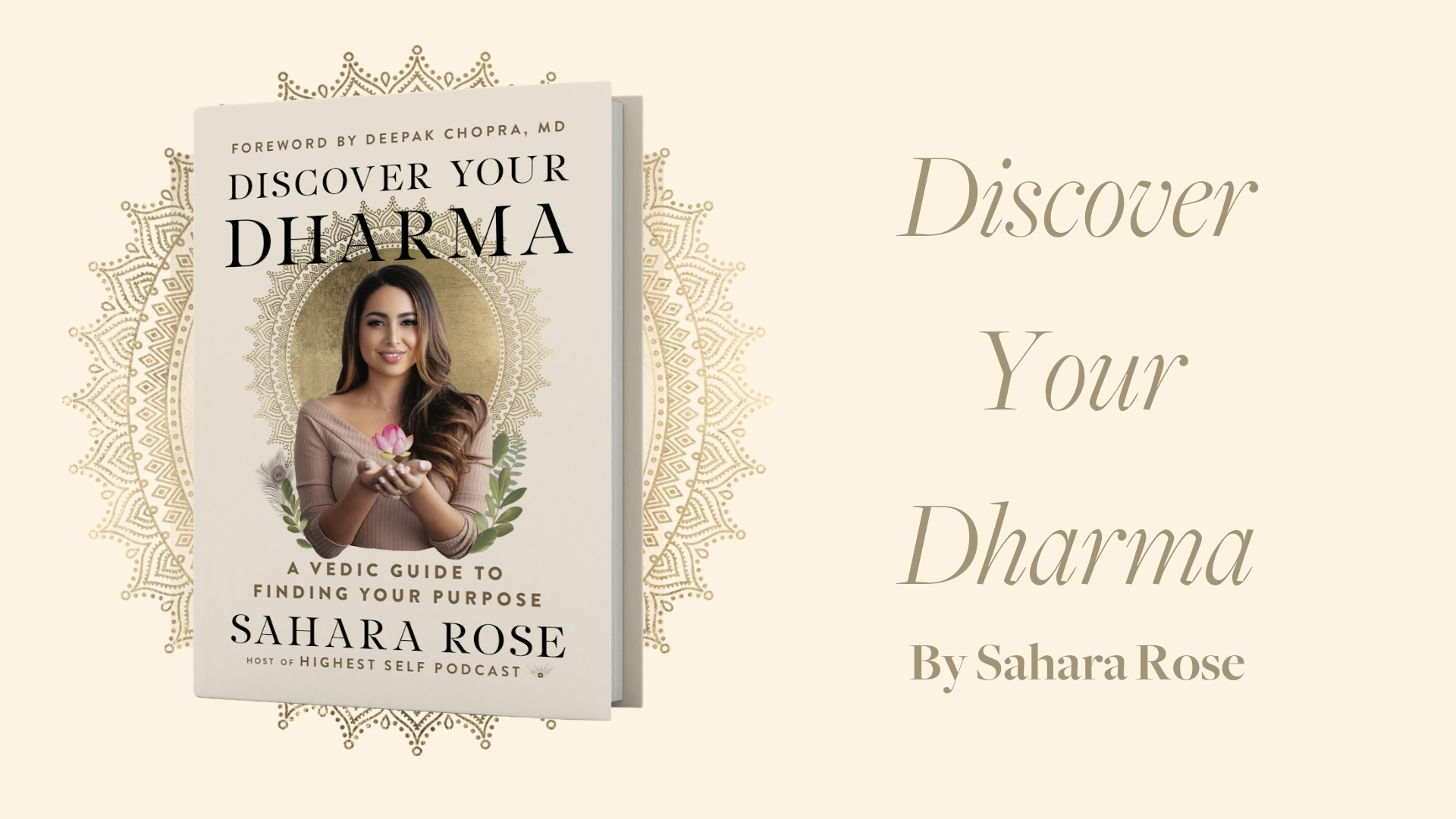
What first opened it up for me as a practical concept was a book. Discover Your Dharma: A Vedic Guide to Finding Your Purpose by Sahara Rose. Not exactly a title you'd expect to find on a corporate executive's reading list. But here we are.
Why this book works
Sahara Rose is a wellness author and podcaster who has spent years translating Vedic philosophy for a modern Western audience. Discover Your Dharma is exactly that... a translation project.
Dharma, in Vedic thought, is your unique contribution to the world. Not your job title. Not your ambition. Your contribution. The pattern that runs through you regardless of the context you're in.
What the book does well is make that concept feel human-sized. Accessible. She strips out the Sanskrit jargon and replaces it with something more practical: what are the recurring patterns in your life that point toward your natural role?
It's one of my favorite books on purpose, full stop. Not because it's the most rigorous or scientifically grounded thing I've read. But because it makes Dharma approachable in a way that most texts on the topic simply don't. If you've ever picked up a book on Eastern philosophy and put it back down after three pages, Sahara Rose's work is worth a shot.
The archetypes
One of the most useful things she introduces is a set of Dharma archetypes. Ten ways of showing up in the world, each grounded in a particular type of contribution.
The Teacher. The Nurturer. The Warrior. The Creator. The Leader. The Healer. The Entrepreneur. The Visionary. The Researcher. The Performer.
Each one is more than a personality type. A Warrior, for example, isn't just someone who's driven. It's someone who sees injustice and genuinely can't walk past it. Who advocates and fights for others as a reflex, not a strategy. A Nurturer doesn't just care about people. Creating safety and belonging for others is how they naturally contribute to any room they enter.
You typically have a primary archetype and a secondary one. They're not rigid boxes. They're more like recurring themes in the way you've always moved through the world.
What I like about this framing is that it shifts the question away from "what should I do?" toward "how am I here to contribute?" That's a more useful question for people at a career crossroads. Job titles change. The underlying pattern usually doesn't.
The quiz (and my honest take on it)
Sahara Rose runs a free quiz on her website that helps you identify your archetype. It takes about five minutes. I've done it. I've sent it to people. I recommend it.
But I'll be straight with you: it's not exactly a validated psychometric assessment.
Some of the questions are fairly leading. If you've read anything about the archetypes before, you can probably guess which one you're heading toward by the third question. The results feel a bit like a very good horoscope... broadly true, personally resonant, and probably flattering enough to make you feel seen.
That's not a reason to skip it. It's a reason to treat it as a starting point, not a verdict.
The real value of the quiz, in my experience, isn't the label it gives you. It's the questions it raises. Do you recognize yourself in the result? Where does it feel right? Where does it feel off? Those reactions are the data.
What Dharma discovery actually looks like
When I use the Dharma framework in coaching, we rarely start with a quiz. We start with questions that go somewhere different.
What do you do for free, repeatedly, without anyone asking? What have you always gravitated toward even when it wasn't practical or paid? When have you felt most like yourself... not most successful, most alive?
One of the most striking moments I've had in a coaching conversation was with someone who'd spent 15 years in finance. Good at it. Well compensated. Quietly off. When we traced back through the moments where she'd felt most like herself, the same thing kept showing up: she'd helped someone through something hard, and it lit her up in a way that nothing in her "career" ever had.
She'd been doing it for years. She just hadn't named it as signal. The Dharma conversation was the first time it clicked into language she could use.
Sahara Rose's book gave her a framework. But the discovery happened in the retelling of her own story.
So, should you take the quiz?
Yes. It's five minutes and it might surface something useful. Here's the quiz. And the book is worth reading alongside it.
Just don't treat the result as your answer. Treat it as your first question.
Your Dharma isn't hidden from you. It's been running through your life the whole time. You just haven't had the language for it yet.
A quiz is a decent first step. The real work starts when you begin looking at the evidence already in your own story. What have you done for free? What have people thanked you for without you thinking it was a big deal? What pattern shows up across every role you've had, even the seemingly unrelated ones?
That's the trail worth following.
If you want a structured way to start that process, the Life Report is a good warm-up. It shows you where things stand across the main areas of your life right now, and that picture often makes the Dharma conversation sharper. You can already see where the friction is. And if you want to go deeper with some structure behind you, that's exactly what the coaching work is for.
I also wrote about this in how to find your purpose without the guru nonsense, if you want a longer version of why frameworks like this matter and why most purpose advice falls flat.