You can't decide your way out of "is this it?"
You can't strategise your way to clarity either. I know because I tried.
And the people I work with, smart, accomplished, mid-career professionals who are excellent at thinking, mostly try the same thing first.
The problem with thinking your way there
The career questions that actually matter aren't the kind your brain solves while sitting at a desk.
"Should I leave my job?" "Is this where I want to be at 60?" "Do I actually want to start the thing I've been talking about for two years, or do I just like the idea of it?"
These don't yield to analysis. They yield to evidence. And evidence only comes from doing.
The book that gave me a frame
I keep recommending the same book. Tiny Experiments by Anne-Laure Le Cunff.
I wrote about it in more depth here, but the core idea compresses to a sentence: stop setting outcome-based goals and start running action-based experiments instead.
You can't control whether you'll find the right next step. You can control what you do this week. So decide on a few specific actions, time-box them, and run them like a scientist. Track what you did, not what happened. After thirty days, look at the data and decide what's next.
It sounds soft. It's not.
What that looked like for me
The decision to coach didn't really come from me. It came out of a run of fifty lunches where four or five people, unprompted, told me the obvious move was coaching. Then another ten where I tried to argue myself out of it.
By the time I'd heard it from enough of them, the decision was made.
But there's a gap between knowing what the work is and actually starting it. I knew what I was going to do. I hadn't done any of it. And the part of me that's good at thinking was very confident I needed a little more clarity before I started.
So I made the actions explicit. Build a web page. Talk about what I was doing publicly, on YouTube and LinkedIn. Show up in the communities where I already was, as someone who was becoming a coach. Give it thirty days. Don't track signups. Don't track engagement. Just track whether I'd done the thing.
The hard part wasn't the actions. The hard part was committing to them before I had any proof they would work.
The run club client
Here's where the theory turned into something real.
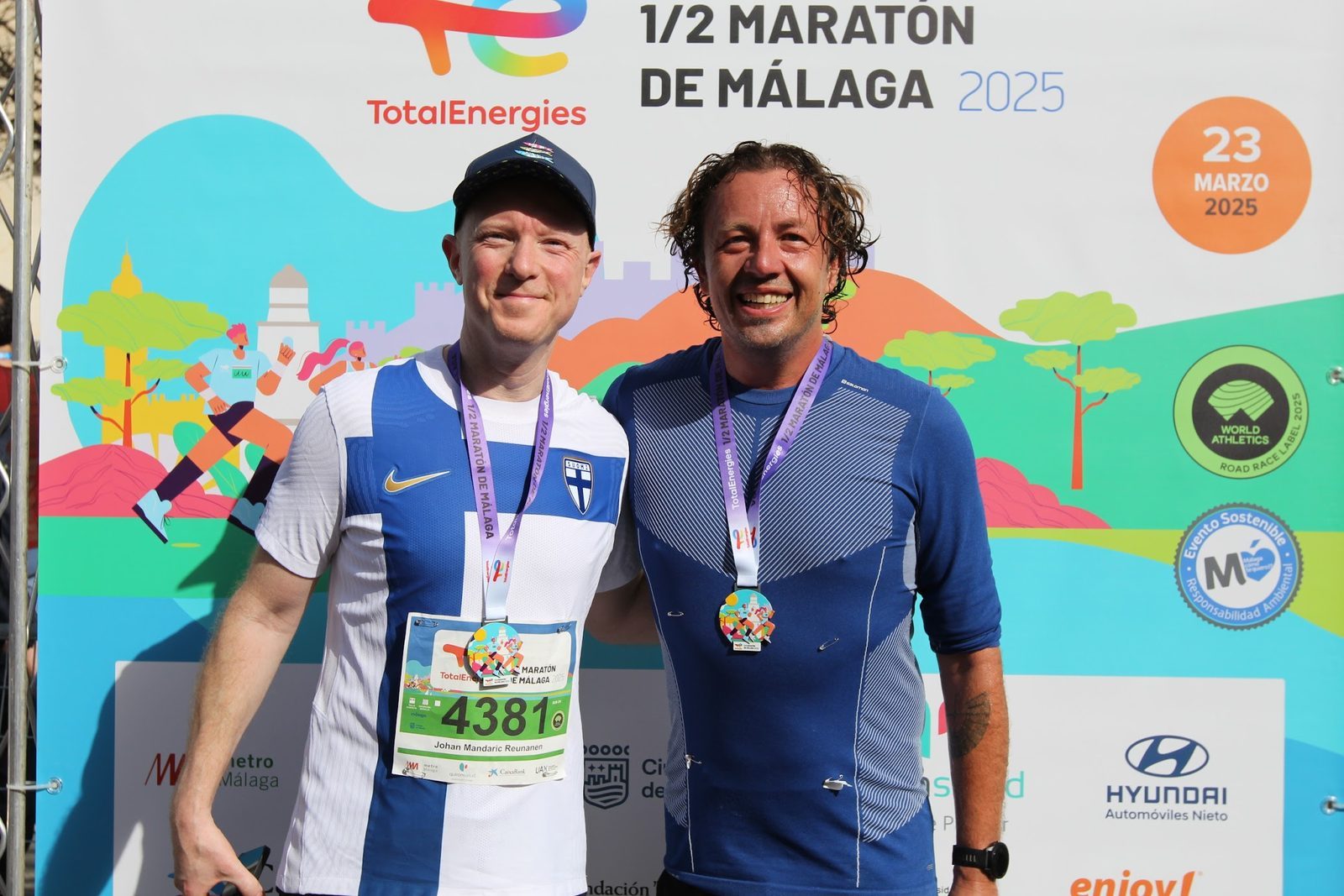
On one of my run-club mornings here in Málaga, someone in the group caught up to me and asked what I did. I told him I was building a coaching practice. I mentioned the podcast. I said I was figuring out who I wanted to work with. We ran. We talked. We finished the route.
That was the whole interaction. I didn't follow up. I didn't push.
A few days later he called. He'd gone home that evening, found the page, watched a couple of episodes. He wanted to have coffee. We met. He told me he'd been looking at the coaching site and thought it might actually be relevant for him.
He became one of my first paying clients.
I hadn't targeted him. I hadn't run a campaign. I hadn't done anything clever. I'd been visible, repeatedly, in a place I was already showing up.
What people call luck
This kind of thing gets called serendipity. Or luck. And there's a version of that which is true. He happened to ask. He happened to look. He happened to be the person.
But the conversation only happened because the experiment was already running. If I'd still been in the planning phase, sitting at home wondering if I should start, that conversation never would have come.
Serendipity is real. But it's also a function of what you're doing. You can't sit in your living room thinking about your coaching business and hope someone finds you on a run.
What this looks like for you
If there's a question you've been turning over for a while and it isn't getting any clearer, the question itself probably isn't the problem.
The problem is that you're trying to think your way through something only doing will answer.
So pick the smallest version of the thing. Not the leap. Not the pivot. Not burning down the current version of your life.
Pick something you could try, this week, that would generate evidence. One conversation with a person you've been meaning to reach out to. One hour spent making the thing you keep saying you'd make. One commitment to show up, once a week, in a context where the right kind of people might happen to notice.
Give it thirty days. Don't measure outcomes. Measure actions.
Then look at what happened. What did you notice? What pulled you in? What didn't?
That data will tell you more than another month of journaling. It will tell you more than personality tests, books, or this blog post.
You can't think your way to the answer. You have to do your way there.
If you want a starting point that maps where the friction in your life is right now, the Life Report is a useful warm-up. It won't tell you which experiment to run. But it'll show you where one might be worth running.